|
|
| has successfully completed the development |
| of several new proprietary features for this |
| non-explosive method for the excavation |
| and secondary breakage of hard rock. |
The method utilizes the proprietary and patent protected Controlled Foam Injection (CFI) technique to fracture rock and concrete. The use of high-pressure foam as the fracturing medium completely eliminates the airblast, flyrock and toxic fume problems associated with explosive based techniques. The CFI method may be used in very close proximity to personnel, sensitive structures or equipment. The controlled breakage characteristic of the CFI method allows for rock removal to controlled dimensions with minimal damage to the remaining rock. All the process byproducts are environmentally benign and completely biodegradable.
Principles of the CFI method 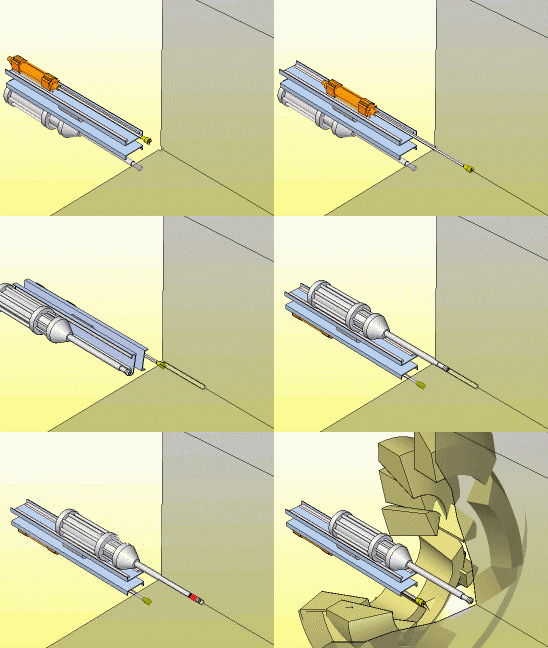
The CFI method is based upon the use of high-pressure foam to initiate, pressurize and propagate controlled fracturing in rock. An injection barrel, incorporating a proprietary hole-bottom seal, is used to rapidly inject high-pressure foam into the bottom of a pre-drilled hole in the rock or concrete to be broken as indicated in the animation at right. The high viscosity of the foam (as compared to a gas) combined with its stored energy characteristics (as compared to a liquid) result in very controlled and efficient breakage. The foam pressures required to break rock are significantly less than required in explosive or propellant based methods. Consequently, airblast and flyrock are reduced to very benign levels, allowing the method to be applied in a continuous manner and to be used in urban and other sensitive environments.
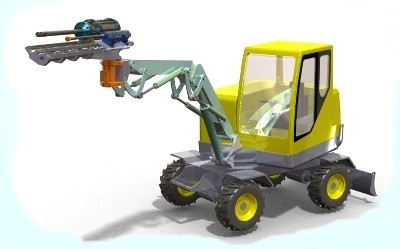
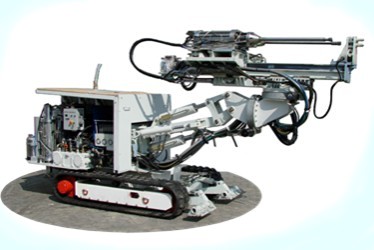
The hardware for the CFI fracture of rock employs conventional hydraulic rock drills to drill the requisite holes and three specialized units for foam generation and the subsequent injection of the foam into the hole. The three units are the CFI breaker to inject the foam, a hydraulically driven gas booster to increase mine air to pressures as high as 8,000 psi and a foam generating unit which mixes the foam liquid with the high-pressure air and delivers the foam to the CFI breaker. The breaker is mounted on an indexing unit on the boom of the machine such that the barrel on the breaker may be inserted in the hole just drilled by the rock drill. The gas booster and foam generator are carried on the main machine chassis and are both powered by hydraulic fluid delivered by the, usually standard, hydraulic pump(s) of the carrier.
The foam is made with a water based liquid and the high-pressure air, in proportions based upon the rock breakage conditions. As the foam comprises water and non-toxic, biodegradable, gels and surfactants the foam may be used without risk to personnel and does not require any special handling for disposal.
Due to the slow rate of fracture propagation and rock breakage, it is neccessary to seal the injection barrel into the holes so that the foam pressure and energy would not escape before breakage was complete. The escape of gas (from explosives or propellants) or liquid (water) via a poorly sealed hole results in the pressure and energy needed for adequate breakage to be much greater than those needed for the breakage proccess alone. CFI Technologies has developed a proprietary hole sealing method, utilizing granular materials in a specialized manner. This hole sealing technique allows for CFI to break hard and highly competent rock, and to do so using a fraction of the energy required in the explosive, propellant or liquid rock breakage used in most currently used methods.
Since the initial technical development and proof of concept were realized on SBIR (Small-Business Innovation Research) programs funded by the National Science Foundation, the CFI technology has been refined and improved in numerous areas. The ability of the method to fracture and excavate both hard massive rock and highly fissured rock has been significantly improved. These improvements have also reduced even further the air blast and fly rock of CFI breakage. CFI systems with these improvements have been integrated with both small track mounted drilling units and with conventional hydraulic excavators, both wheeled and tracked. The CFI technology has reached levels of design, operation and demonstrated performance such that the technology can now be integrated into a variety of carriers for application to dedicated commercial rock breaking projects.
The CFI method is well suited for automation. The flexibility of the method (in terms of hole depth and foam pressure, quality and viscosity) allows it to be tailored to rapidly changing ground conditions or a variety of breakage conditions. The benign nature of the airblast and flyrock of the CFI fracturing method allows drilling, breakage, mucking, ground support and haulage equipment to remain at the working point or face during rock excavation operations. Operating personnel may control operations by radio-remote from nearby, line-of-sight, locations or from a protected cab providing direct observation of operations.
The CFI method is ideally suited for any excavation or rock breakage situation where conventional explosive methods are precluded, whether for environmental, legal or public concern reasons.
Applications of CFI breakage
The proprietary foam-based CFI method can be used in a broad variety of rock breaking and excavation situations. The method is ideally suited for the demolition of oversized boulders encountered in both construction and mining operations. The CFI method can be used to develop trenches for utility or pipe lines or caisson shafts for bridges and power line towers. The method can be used to excavate utility tunnels under existing streets and buildings, to provide access tunnels or shafts to existing subway systems, or to create or enlarge underground space for buildings.
In underground mining operations, the CFI method can be used for selective mining or for mine development in unstable ground. As the method imparts negligible damage to the remaining rock, the need for ground support can be significantly reduced.
For additional details on the development and commercialization of the CFI method or to discuss specific applications please contact:
Chapman Young
CFI Technologies LLC
P. O. Box 772129
Steamboat Springs, CO 80477
Phone: 303-807-9343
E-mail: cfi@capprex.com
Please visit our known visitors page for details, news, video clips, publications and reference information.
If you need the password please call 303-807-9343 or e-mail us at: cfi@capprex.com
Once you have the password enter it below: